Accountable ownership
Your leadership can name who owns the answer, the exception, and the customer outcome — before the agent takes on more work.
Semop Consulting · AI for regulated environments
A small failure in a regulated agent can become a safety, regulatory, or trust event. Semop Consulting helps teams put agentic AI into production one verifiable control at a time — control the input, ground the answer, control the output, and watch the system — so the business and its stakeholders can trust what scales.
Built for regulated environments
In healthcare, financial services, the public sector, and other regulated settings, an agent carries your organization's obligations. A small error can become a safety, privacy, or trust event, and every stakeholder — risk, security, audit, and the people doing the work — has to see how the system is controlled.
Your leadership can name who owns the answer, the exception, and the customer outcome — before the agent takes on more work.
Every material answer traces to an approved, current source from a controlled context layer built from your business data and documents. Conflicts are shown, not smoothed, and the release decision has a record.
Your team can monitor, review, change, and stop the system without rebuilding it or depending on the original prototype team.
We assess one agent system against the conditions that decide whether it can scale, then build the controls in the order a failure can travel: input screening, approved context, a fixed output format with claim checks, and monitoring. The work fits the stack and the team you already have.
The agent knows what it may answer, when to hand off, and when to stop. Every answer must fit a fixed format; an unsupported or malformed answer is stopped before release.
Answers are built from an approved context layer, not from whatever the model happened to retrieve. Every source has an owner, date, and version.
Your team can see whether the system is ready, what failed, and what changed as usage grows — and who owns the next decision.
We usually recommend starting with the Production Scale Assessment: one agent system, the six conditions for scale, and a written read of what the evidence supports. Explore all solutions
Demo · reference build
Nine prepared screens: the patient flow and the internal QA review surface. Synthetic data only; not a product and not a client deployment.
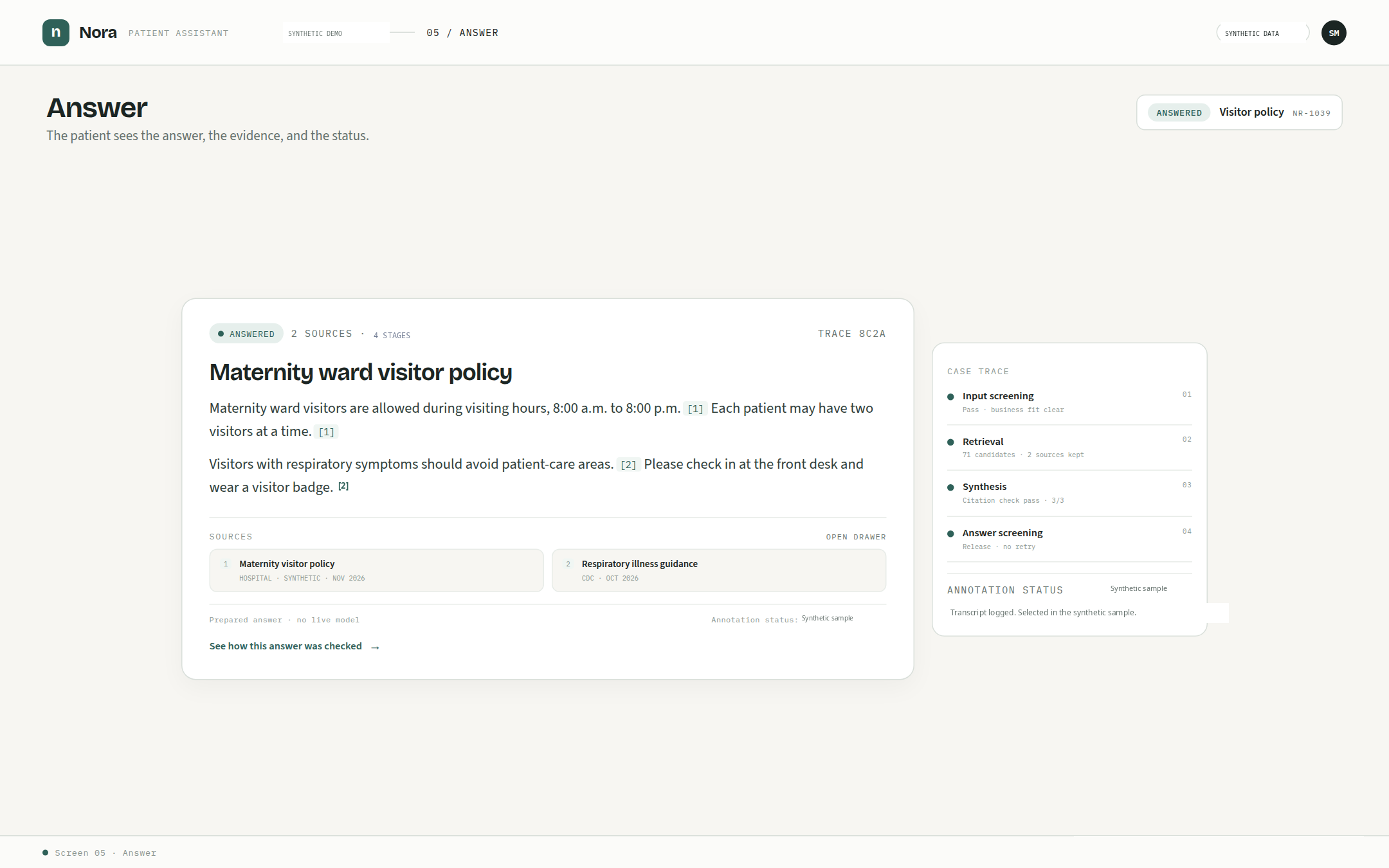
A small input or an unsupported sentence can carry a large cost. The demo shows the controls in order — input screening, approved context, output format and citation checks, and human QA — so a reviewer can see what was stopped, what was cited, and what reached the patient.
No client logos. No composite scores. A small set of work that shows the method: input control, grounded context, output checks, and a record you can defend.
A bilingual drafting system for governed project documents in Copilot: charters, business cases, benefits plans, risk assessments, and gate decks. Project managers use it; the human still signs.
Release controls at hospital-network scale: input screening, consistent answers, evaluation, and monitoring for severe events.
A reference implementation that publishes a quotation only after it matches the source, with a verification record over synthetic documents.
Sensitive data, including PHI/PII, stays in your environment by default. The audit record keeps the question, the sources retrieved, the screening and release decisions, and the answer. It does not copy system prompts or hidden model reasoning. Annotation runs on your infrastructure or a client-approved processor. Semop does not host a copy.
The user-visible conversation, citations, and the step-level results needed to defend an answer, in a client-controlled record. Retention follows your policy; the default is 90 days after close. System prompts and hidden model reasoning are not copied.
Operational logs carry metadata only: latency, error codes, token counts, request counts. Prompt and answer text are not written to application, gateway, or trace logs. Default retention is 30 days.
Annotation runs on client infrastructure, or a client-approved processor under the engagement's data terms. Named access, logged; no cross-client reuse. Flagged and emergency transcripts stay within the audit record.
PHI/PII is masked before content reaches a model by default; unmasked data requires your approval. Any model that could see unmasked PHI/PII is approved by your security process. No training on client data.
Semop Consulting is an independent practice focused on one problem: how to put agentic AI and automation into work that has to withstand scrutiny. The starting point is the decision the system supports, the owner who is accountable for it, and the evidence a reviewer will need.
The model is only one part. We build in the order a failure can travel: control the input, ground the answer in owned context, control the output with a fixed format and verified claims, then watch the system with human review and realistic-change tests. That is how a regulated team earns trust with its stakeholders.
Semop Consulting is led by Frank Meng, who has worked across regulated healthcare, public-sector AI, and production machine-learning systems. The practice is deliberately small: one engagement at a time, with the person doing the work close to the client.
The assessment and build are scoped to your requirements; advisory is monthly. Scope, acceptance criteria, and fee are agreed in writing before work starts.
A scoped assessment of one agent system against six conditions for production scale: findings, scale blockers, and a written read.
Scoped in writing
A defined agent, context, or evaluation system, scoped to acceptance criteria.
Milestones · scoped in writing
A monthly review of architecture, evaluation, and rollout decisions.
Monthly retainer · scoped in writing
Every engagement starts with a written scope. We usually recommend starting with the assessment.
What business, risk, and technology leads usually ask before the first call.
Usually a Production Scale Assessment of one agent system. It ends with a written read: what is verified, what is missing, and what blocks the next stage. If the record supports a build, the next step is a scoped build proposal. If it does not, the record is yours and there is no obligation to continue.
A typical assessment runs two to four weeks after the scope is agreed. The window includes the normal back-and-forth between framing, inspection, testing, and readout. Client review, approvals, and access sit outside that window; the written scope fixes the calendar.
Fees are agreed in writing from your requirements, with no open-ended billing. Start an inquiry and we will scope the work and the fee with you.
Semop Consulting is a small independent practice. Frank Meng leads the work and is your point of contact from scoping through delivery. If a build needs another person, that person is named and approved before client data access. There is no standing team or bench behind the practice.
Yes. The assessment and the build start from the agent, retrieval, evaluation stack, and people you already have. Replacing the stack is a last resort. The goal is a system your team can own, not a dependency on us.
A larger firm can bring a bench and broader delivery capacity. We are the better fit when the problem is one agent system, the decision needs a named senior owner, and you want the method, evidence, and handover to stay with your team. The trade-off is focus: one engagement at a time, with no standing team or bench. See how we work.
Client work stays private; public showcases are anonymised and labelled. Sensitive data, including PHI/PII, stays in your environment by default. The audit record keeps the user-visible conversation and the step-level results needed to defend an answer, in a client-controlled store. Operational logs carry metadata only. System prompts and hidden model reasoning are not copied. Annotation runs on your infrastructure or a client-approved processor. Semop does not host a copy. Retention follows your policy: 30 days for operational logs, 90 days after close for the audit record, 30 days for backups after deletion; shorter is always allowed, longer only in writing. Any model that could see unmasked PHI/PII is approved by your security process first; masking is tested on your documents; no training on client data and no cross-client reuse.
Send the deployment and the decision it supports. You will get a reply within one business day and a short call to decide whether an assessment or a build is the right next step.